Plan Your Best Trip Ever!
"Toronto"

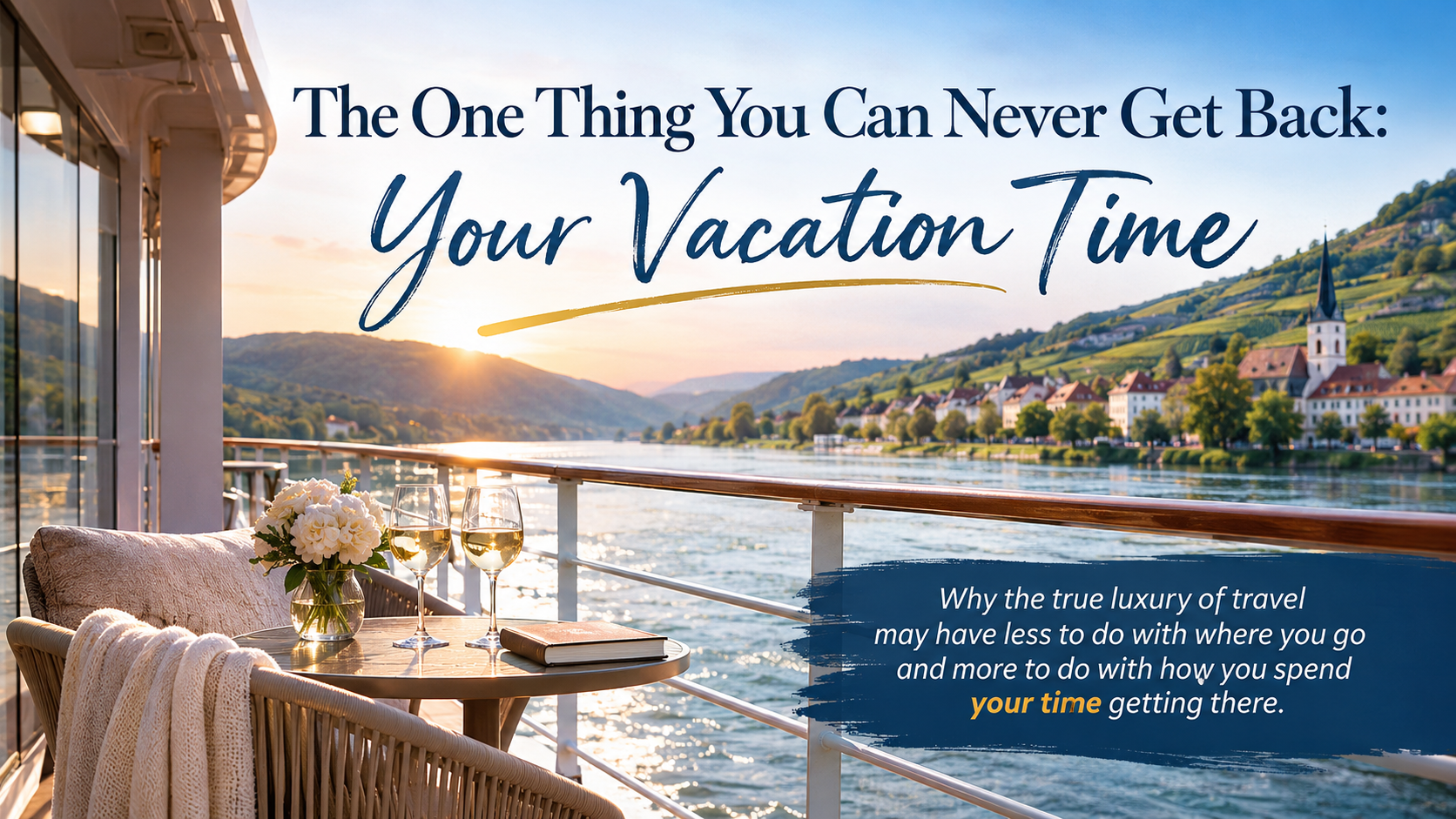
Why the true luxury of travel may have less to do with where you go and more to do with how you spend your time getting there.
We spend much of our working lives watching the clock.
Meetings, appointments, deadlines, responsibilities, and endless commitments. Our calendars fill up, our days disappear, and before we know it, another year has passed.
Then, finally, we take a vacation.
And what do we do?
Sometimes, we fill those precious days with so many activities, transfers, hotel changes, and destinations that we return home feeling as though we need another vacation.
I've often said that our vacation time is one of our most precious non-renewable assets. We can earn more money. We can replace possessions. But we cannot buy back yesterday.
A recent article by João Miranda, Director of Sales at AmaWaterways, titled Stop Selling Trips. Start Selling Time., inspired me to revisit this idea from the traveller's perspective.
João makes an important observation about how we value travel. We spend considerable time comparing prices, destinations, and inclusions, but perhaps not nearly enough time considering how much of our vacation we actually get to enjoy.
It is a perspective I wholeheartedly agree with, and one that helps explain why I have become such a strong advocate for cruising.
Think about how we traditionally plan a European vacation.
We have two weeks, perhaps three if we're fortunate.
We want to see Paris, Amsterdam, Vienna, Budapest, and maybe squeeze in Prague.
The temptation is to include as many destinations as possible. After all, who knows when we'll return?
But there is a difference between visiting a destination and experiencing it.
I've travelled to all seven continents, and some of my most memorable travel experiences haven't involved famous landmarks or meticulously planned excursions.
They've been the unhurried moments.
Sitting at a café watching local life unfold. Wandering through a neighbourhood without a particular destination. Enjoying a conversation over lunch without worrying about when the next bus departs.
Those moments require something that no itinerary can manufacture - Time.
Imagine a ten-day European journey involving four or five different hotels.
Each hotel change comes with its own routine.
You pack your suitcase, check out, arrange transportation, travel to the next destination, check in, and eventually unpack again.
Perhaps your new room isn't ready. Perhaps there's traffic, a delayed train, or a transfer that takes longer than expected.
Even when everything goes smoothly, these transitions consume time and energy.
Now consider what happens when you travel along some of Europe's great rivers.
You unpack once.
Your accommodation travels with you, often while you're enjoying dinner, relaxing in the lounge, or sleeping.
You wake up in another destination, ready to explore.
There is no suitcase to repack, no hotel checkout, and no need to arrange transportation between each overnight stop.
Of course, river cruising still involves schedules, excursions, and occasionally transfers. It isn't entirely free of logistics.
But removing repeated hotel changes can make a remarkable difference to how a vacation feels.
You're spending more of your holiday being somewhere rather than getting somewhere.
There's another aspect of travel that we rarely consider when comparing prices.
The mental energy involved in making decisions.
Where should we eat tonight? How do we get to tomorrow's attraction? Do we need tickets? Is there a train? How much time should we allow? Where do we leave our luggage?
Individually, these decisions might seem insignificant.
Collectively, they can become exhausting.
One of the things I particularly appreciate about a well-designed cruise experience is that many of these arrangements have already been considered.
Your accommodation is ready. Meals are available. Excursions can be organized. Transportation between ports is part of the journey.
Depending on the cruise line and itinerary, many of these services may also be included in the fare.
You still have choices, and plenty of them.
But you don't have to make every decision yourself.
And sometimes, having fewer decisions to make is one of the most relaxing parts of being away.
Although João's original article focused on river cruising, I believe the principle extends to ocean and expedition voyages, although the benefits can be quite different.
Consider an ocean cruise through the Mediterranean.
You might explore historic cities, coastal villages, and several countries while returning each evening to the same comfortable stateroom.
Your ship becomes a familiar home, allowing you to experience different destinations without repeatedly changing accommodations.
Or consider an expedition voyage to Antarctica.
Here, the value of your time takes on an entirely different meaning. You're travelling to one of the most remote and extraordinary places on Earth, aboard a specially equipped expedition ship designed to navigate polar waters and support exploration ashore.
Your ship is not simply your accommodation. It is your transportation, your base for exploration, and your connection to an environment that few people will ever experience.
With an experienced expedition team managing the complex logistics of landings, Zodiac excursions, and daily activities, you can concentrate on what brought you there in the first place: the wildlife, the landscapes, and the extraordinary experience of being in Antarctica.
Of course, weather, sea conditions, and ice determine what is possible each day. Flexibility is an essential part of expedition travel.
But that's precisely the point. You're not spending your time organizing the journey. You're spending it experiencing a destination that would otherwise be extraordinarily difficult for most travellers to access.
Whether it's a river journey through Europe, an ocean voyage across the Mediterranean, or an expedition to Antarctica, the advantage isn't always about saving a specific number of hours.
Sometimes it's about reducing the time spent on logistics. Sometimes it's about having access to experiences that would otherwise be difficult to arrange.
And sometimes it's simply about being able to concentrate on the journey itself.
When comparing vacations, we naturally look at the price.
A river cruise might initially appear more expensive than a land-based vacation.
But are we comparing the same things?
Consider the accommodation, meals, transportation between destinations, excursions, and other services that may be included.
Then consider the less obvious costs.
The hours spent organizing transportation. The repeated packing and unpacking. The waiting. The decisions. The energy consumed simply getting from one place to another.
Not all of these have a dollar value.
But they certainly have a value to the traveller.
And that raises a question I think we should ask more often:
What is an extra day of genuinely enjoyable vacation time worth to you?
Not an extra day added to the itinerary.
An extra day reclaimed from unnecessary logistics, waiting, and rushing.
For some travellers, that could be worth considerably more than a modest difference in the price of the vacation.
I also believe we need to challenge the idea that a successful vacation is measured by how many places we've visited.
There's nothing wrong with an ambitious itinerary. Some travellers genuinely enjoy moving quickly, exploring independently, and experiencing as many destinations as possible.
But I wonder how many of us have returned from a trip remembering the places we hurried through rather than the places we truly experienced.
Would you rather visit six cities briefly or have the time to appreciate four?
Would you rather spend another morning transferring between hotels or linger over breakfast overlooking the Danube?
Would you rather arrive home with a longer list of destinations or a deeper collection of memories?
There is no universally correct answer.
But these are questions worth considering before making a travel decision.
This philosophy also influences how I approach my work as a travel advisor.
My role isn't simply to find a cruise that visits the destinations on your wish list.
It's to understand how you want to experience those destinations.
Perhaps you prefer a smaller ship. Perhaps you enjoy independent exploration. Perhaps you want included excursions, more time in port, or an itinerary with fewer sea days.
Maybe you want to see as much as possible, or perhaps you're at a stage in life where slowing down has become more important.
The right vacation is not necessarily the one with the longest list of ports, the most inclusions, or even the lowest price.
It's the one that makes the best use of your time, according to what matters most to you.
And helping travellers make those distinctions is where I believe a knowledgeable travel advisor adds real value.
There will always be another itinerary to compare, another destination to consider, and another cruise promotion to evaluate.
But the number of vacations we have ahead of us is not unlimited.
That becomes increasingly meaningful as we move through different stages of life.
We begin to recognize that travel isn't simply about seeing the world.
It's about how we choose to spend our time in it.
So, the next time you're planning a vacation, I'd encourage you to look beyond the price, the number of countries, and the list of attractions.
Ask yourself one more question.
How much of this vacation will I actually spend enjoying the experience I travelled so far to have?
Because ultimately, the greatest luxury may not be a larger suite, a more expensive hotel, or another destination on the itinerary.
It may simply be having more time to enjoy the journey.
At TravelOnly with Ken, I specialize in helping travellers discover premium and luxury ocean, river, and expedition cruises that suit their interests, expectations, and travel style.
If you're considering your next journey, I'd welcome the opportunity to discuss not just where you want to go, but how you want to spend your time getting there.
TravelOnly with Ken
https://kengraham.travelonly.com
Acknowledgement: This article was inspired by João Miranda's November 1, 2026 LinkedIn article, "Stop Selling Trips. Start Selling Time." João is Director of Sales at AmaWaterways. His original perspective on valuing travellers' time prompted these additional reflections on the benefits of ocean, river, and expedition cruising. The opinions and examples expressed here are my own.
"Toronto"
 Ken Graham
Sign up for our newsletter to learn about the latest product news and deals. Also receive exclusive offers, contest details and giveaways.